Stradner: KFOR withdrawal would destabilize Balkans
Z.Qorraj/RTKlive
The security situation does not favour a KFOR withdrawal. Russia, despite suffering major losses in Ukraine, has not abandoned its efforts to destabilize Europe. For Moscow, the Balkans are a low-cost arena and an opportunity to test whether NATO is a paper tiger.
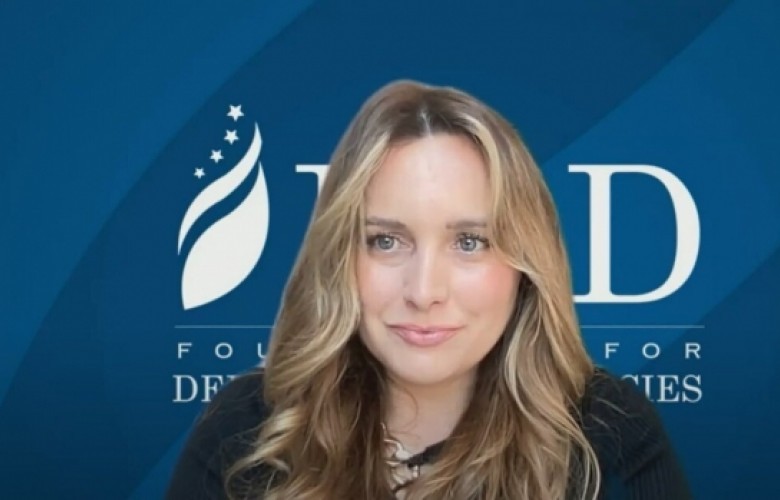
The clashes in Kosovo in May 2023, which left more than 90 KFOR troops injured, as well as the attack in Banjska, demonstrated how quickly a local incident can turn into a regional crisis. The danger has not passed, warns American security analyst and expert Ivana Stradner in an interview with RTKLive.
The reasons behind Serbian President Aleksandar Vucic's decision to concede defeat and announce the Student List's victory at 21:30 on October 25, 2026, are being investigated by leading regional and international media outlets.
The British newspaper The Times has reported that Vucic had planned a violent scenario on election night to remain in power but eventually abandoned it. According to the report, this was due not only to the Student List receiving nearly 600,000 more votes than him, but also to warnings from several European Union officials.
American security analyst Ivana Stradner says that, although she has no reliable information about exactly what happened on the night of October 25, the claims published by The Times do not surprise her.
"Several days before the elections, I reported on what was happening within Serbia's police and special units, how they were preparing and being deployed. I was almost certain that Aleksandar Vucic was ready to create chaos. He has repeatedly demonstrated that violence against Serbian citizens is nothing unfamiliar to him.
"For months, masked and hooded individuals have been spreading fear and attempting to intimidate everyone who has criticized or opposed the regime. People have been run over, arrested and beaten. Organized crime had long since ceased to be organized. Just look at the Alta Bank affair! Who knows what else we will see," Stradner told RTKLive.
The American analyst added that what the public in Serbia and the region has witnessed in recent days represents only part of the explanation for why Vucic's regime felt compelled to defend itself at all costs.
RTKLive: If reports about Serbia's special units and police being prepared to intervene are true, what was the plan?
IVANA STRADNER: Vucic wanted to provoke unrest, prolong negotiations over the recognition of the election results and thereby buy time. We have seen this in Georgia. The objective was escalation because Vucic has always counted on the West becoming frightened and taking no action.
He has been doing this for years: provoking escalation, intimidating the West and then presenting himself as the only person capable of extinguishing the fire he started himself. This time, however, his calculation did not work.
RTKLive: Why?
STRADNER: The Student List received nearly 600,000 more votes than he did, and such a result is difficult to challenge. Add to that the warnings from officials in several European countries, as reported by The Times, and it becomes clear that Vucic's defeat was inevitable and that the price of attempting to remain in power was simply too high.
Perhaps we will never learn what actually happened behind closed doors. Nevertheless, I am certain of one thing: the West is tired of Vucic's regime. A regime that has destroyed democracy and the rule of law is not a partner but a threat to Brussels and Washington. The rule of law, meanwhile, is essential for foreign investment.
We should also remember the regional dimension of Vucic's rule. For years, his escalations in the region have been a tool of pressure rather than a policy of peace.
In this sense, what happened in Belgrade on October 25 is not merely a change of power but also an opportunity for Serbia to stop being a source of instability and become a reliable partner. Whether Belgrade seizes this opportunity will depend on the actions of the new authorities during their first months in office.
RTKLive: In his first public appearance after the elections, Vucic said that the outcome had also been influenced by the American "deep state", referring to structures that are "against President Donald Trump". How do you interpret this statement?
STRADNER: This does not surprise me either. For years, Vucic has been talking about colour revolutions and the West wanting to overthrow him.
We know that every authoritarian regime is paranoid because it cannot accept that citizens rise up against it for their own reasons. And this is not accidental. According to reports, Russia and Serbia established a working group several years ago to combat colour revolutions.
Vucic himself has frequently described protests and elections as attempts to stage colour revolutions. At the same time, Russia has promoted the narrative of a "Serbian Maidan", while Russian Foreign Minister Sergey Lavrov has publicly warned about alleged attempts to organize colour revolutions.
In other words, this is the same scenario Slobodan Milošević used during the 1990s.
RTKLive: In what sense?
STRADNER: In the sense that someone from abroad is always blamed, rather than the government that has lost the trust of its citizens.
Another interesting detail you mentioned is that this time Vucic tried to flatter Trump, who himself criticizes the "deep state". Clearly, he calculated that by accusing the same people Trump accuses, he would find sympathetic interlocutors in Washington.
However, he failed to understand that Trump is not particularly interested in Vucic and that Washington knows very well who Vucic is. They have been observing him for years. They know how he has behaved, whom he has cooperated with, what he has promised and what he has actually done.
Ultimately, Serbian citizens did not go to the polls because of the "deep state", but because of corruption, violence and a lack of the rule of law. Those 600,000 votes did not come from foreign offices.
As you may recall, Vucic had announced that he would write a book entitled How I Defeated the Colour Revolution. What will he call it now? Perhaps How the Deep State Defeated Me? Or will it remain in a drawer, like most of the promises he has made?
RTKLive: During Aleksandar Vucic's rule, Serbian society has become deeply Russified, something that the EU and the United States tolerated for a long time. Representatives of the Student List say they will not impose sanctions on Russia and that European integration is not currently a priority. Does this concern you?
STRADNER: Let us start with Vucic, because he is at the root of the problem.
When he came to power, he promised to bring Serbia closer to the West, although he did precisely the opposite: he brought it closer to Russia and China. At the same time, he kept Serbia on the European path because EU pre-accession funds helped keep him in power.
He never had a genuine intention of bringing Serbia into the EU because that would have meant establishing the rule of law and, consequently, the end of his regime.
Serbia and Russia have conducted numerous joint military exercises. Moscow had invested in military and security cooperation even before Russia's invasion of Ukraine.
The fact that Vucic sold weapons to Ukraine led many to believe that he was pro-Western. However, this was not about ideology but business. The arms trade is profitable, and Vucic would sell weapons to anyone willing to pay.
In return, he gave Putin the opportunity to use Serbia to circumvent sanctions and strengthen security cooperation.
Serbian and Russian intelligence services have a long history of cooperation. Russia's intelligence service has publicly supported Vucic on several occasions and accused the West of preparing a "colour revolution".
Furthermore, Russia opened the Russia Today (RT) and Sputnik television channels in Serbia, which was not accidental either. Moscow has used Serbian territory to train individuals for destabilization operations across Europe, including in Moldova.
However, Vucic is not a victim of Russia.
RTKLive: What is he, then?
STRADNER: Vucic is an accomplice. His domestic propaganda has amplified some of the worst Russian narratives, including claims that Ukraine attacked Russia and that the United States operates biological laboratories in Ukraine.
As a former Information Minister under Milošević, Vucic understood perfectly well that whoever controls information wins. That is why he first destroyed independent media.
The media under his control did not merely spread disinformation but also hatred and violence, which subsequently reverberated throughout society. The result has been polarization and hostility towards the region, precisely the same approach used by Milošević.
RTKLive: But why did the West tolerate this for so long?
STRADNER: Because stability was more important to it than democracy.
RTKLive: What about the students?
STRADNER: The student movement is complex. It includes the right, the left, the centre and people with different political and ideological backgrounds.
What united them was their opposition to Vucic's authoritarianism and corruption. Their stated goal is the rule of law, which represents a step in the right direction.
The problem is the lack of a foreign policy vision. Nevertheless, after more than two decades of anti-Western sentiment, it is difficult to expect young people in Serbia to become pro-Western overnight. Perhaps they need time.
It is also possible that, ahead of the presidential elections, they are acting strategically and promoting pro-Russian narratives to avoid losing part of their electorate.
Yes, I am concerned by their statements that they will not impose sanctions on Russia. I believe that the only path to Serbia's future is towards the European Union, which also means imposing sanctions on Russia.
You cannot build the rule of law while remaining economically and politically tied to a regime that openly despises it.
Neutrality in this case is not neutrality but a postponement of a decision. The price of that delay will continue to rise.
That is why I expect the new authorities, once they stabilize the institutions, to clearly demonstrate which direction Serbia intends to take. The first test will come in a few weeks.
RTKLive: What could that first test be?
STRADNER: The start of negotiations with Russia on energy agreements.
The new authorities in Belgrade must understand that NIS is the centre of Russian influence in Serbia, an instrument through which Putin exerts pressure on the country.
If Belgrade is serious about Serbia's future, it should nationalize NIS and open the door to Western energy companies.
The second test concerns the intelligence services. Like Russia, Serbia operates as a system whose key components are the BIA and military intelligence agencies.
Once we see who will head these institutions, we will know everything we need to know about the direction Serbia is taking.
In other words, if the same personnel and connections remain in place, it will mean that only the name on the door has changed while everything else remains the same.
Serbia has an opportunity, but it will be judged by its decisions on energy and security, not by statements on social media.
RTKLive: There is speculation that President Donald Trump's administration is considering withdrawing American troops from Kosovo. What would this mean for stability in Kosovo and the region?
STRADNER: First of all, it is important to understand the scale of such a move. We are talking about approximately 600 American soldiers serving within KFOR, representing only a small fraction of the US military presence in Europe.
Their withdrawal would generate almost no savings, while the political and security costs could be extremely high.
I understand why Washington is reassessing its military presence in Europe. For many years, the United States has called on its European allies to assume greater responsibility for their own defence. It is therefore legitimate to ask where American forces provide particular value.
But KFOR is precisely such a mission. The American role is as much political as it is military, and it would not be easy to replace.
For many years, KFOR has maintained peace between Kosovo and Serbia and acted as a political deterrent against those seeking to provoke violence.
American credibility has been built over 25 years, under both Republican and Democratic administrations. The current security environment does not favour a withdrawal.
RTKLive: Why?
STRADNER: Because, despite suffering major losses in Ukraine, Russia has not abandoned its efforts to destabilize Europe.
For Moscow, the Balkans are a low-cost arena and an opportunity to test whether NATO is a paper tiger.
The clashes in Kosovo in May 2023, which left more than 90 KFOR troops injured, as well as the attack in Banjska, demonstrated how quickly a local incident can turn into a regional crisis. The danger has not passed.
Meanwhile, Serbia is forming a new government following the elections, but Belgrade's future direction remains uncertain. Moscow is well positioned to exploit this vacuum.
In recent weeks, Russian officials have repeatedly described the security situation in Kosovo as alarming and stated that they would accept only a solution for Kosovo that is fully acceptable to Belgrade.
That is why any signal of a KFOR withdrawal would be dangerous. It could encourage security ambitions not only in Serbia but also separatist tendencies in the Republika Srpska entity, which are becoming increasingly frequent.
This could lead to the emergence of two fronts for which Europe, and particularly the United States, are not prepared.
Following the Banjska attack, KFOR demonstrated that it could increase troop numbers and provide credible deterrence.
In other words, when NATO strengthened its presence, Vucic immediately reduced military tensions.
Tamara Nikcevic is an RTK contributor covering regional affairs.