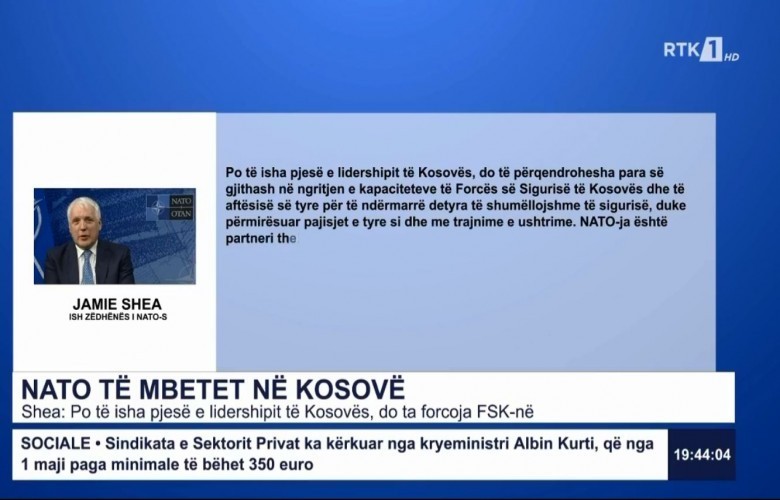
Shea for RTK: NATO in Kosovo, until Serbia recognizes Kosovo independence
In an exclusive interview with RTKlive, Jamie Shea, a NATO spokesman during the spring 1999 air campaign against Serbia, said NATO in Kosovo, until Serbia recognizes Kosovo independence.
Interview:
RTKlive: 22 yeaars after NATOs air campaign against military targets of Serbian Army which ended the war and resulted with deployment of NATO troops to Kosovo, do you think that international military presence is still needed to preserve the peace?
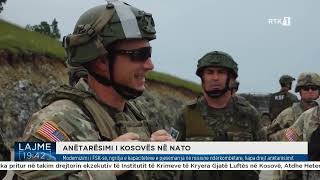
Yes, i believe the NATO KFOR military presence is still needed in Kosovo. The first reason is a very pragmatic one. As long as NATO and many KFOR troop contributing countries have a presence in Kosovo they will have the country on their diplomatic radar screens. The NATO Secretary General and NATO foreign and defence ministers will visit Pristina periodically. They will take an interest in Kosovo and keep close contact with the political leadership. They will also take a keen interest in the Pristina-Belgrade negotiations and Kosovo’s future security in the region. This is particularly the case of the United States and those other allies that are not EU members and thus not formally connected to the Pristina-Belgrade dialogue. This broad international involvement is to Kosovo’s advantage. This first element is linked to my second reason. The political and security situation between Serbia and Kosovo is still fragile. I do not see amother conflict but I think that the continuing presence of KFOR exerts a moderating influence and rules out any unilateral or extremist moves. It helps to keep both Pristina and Belgrade focused on the diplomatic track. It also reassures all the people of Kosovo that they have a secure future inside the country. I believe KFOR should remain in Kosovo until Serbia formally recognises an independent, sovereign Kosovo and relations are fully normalised. As I have said in the past, I do not think that Serbia should join the EU until it has recognised Kosovo abd also supports its future EU candidacy. Third, and finally, KFOR helps to form and train the Kosovo Security Forces (KSF). It develops the partnership arrangements between NATO and Pristina. By bringing the KSF closer to NATO standards, it facilitates Kosovo’s integration into the Euro-Atlantic structures. I hope that soon Kosovo will be able to participate fully in NATO’s Partnership For Peace and have access to all the cooperative tools and activities that it offers.
RTKlive: Kosovar Parliament has voted to change the mandate of Kosovo Security Force from an emergency respose force towards becoming fully-fledged Armed Forces. SG of NATO Mr. Stoltenberg, said recently “the decision (to change the mandate) was taken against the NATOs Council suggestion and that NATO continues to support the development of the Kosovo Security Forces under their original mandate, ie the emergemcy response force”. Do you think that Kosovo should have its own Army?
If I were part of the Kosovo leadership I would focus first and foremost on building the capabilities of the Kosovo Security Forces and their ability to undertake multiple security tasks through equipment improvements and training and exercises. NATO is an essential partner in this connection. At this stage I would not worry about labels and symbols like “Kosovo army”, especially as they are not helpful at the moment in terms of guaranteeing Kosovo its essential support from the transatlantic allies. Let’s rather see how we can maximise the development of the KSF within the existing mandate and make them as far as possible interoperable with NATO. Labels matter less than the question: is the KSF able to protect the security of all the citizens of Kosovo in handling immediate challenges like the Covid 19 pandemic, natural disasters and the resilience of critical infrastructure? One very welcome development is that a KSF unit is to deploy to Kuwait to join an international peacekeeping mission. This type of international cooperation should also be a priority as it will give the KSF valuable experience. So let’s focus on making the KSF effective for internal security as KFOR is there to uphold external security.
More than two decades after the war and 13 years after Kosovo declared its independence, still there is no agreament with Serbia, although two countries have been negotiationg under facilitation and mediation of the EU. In meantime, there was an attempt of the US administration to speed-up the process of mutual recognition. Do you think that there will be in the near future a final agreement between the two countries?
I think the reconciliation between Greece and North Macedonia (with the latter now inside NATO) or the recent recognition of Israel by four Arab and Muslim countries demonstrates that even the most intractable disputes can suddenly unfreeze. So yes there will be sooner or later an agreement between Pristina and Belgrade. Kosovo is an independent country and Serbia knows this. So what is the alternative? An agreement is overwhelmingly in both countries’ interests and crucial for political stability and economic growth in the Western Balkans. A lot of the necessary groundwork has already been completed in the EU-sponsored Pristina-Belgrade dialogue and the agreement negotiated by the Trump administration. The US-EU coordination will be crucial and the Biden administration is full of old Balkans hands who know the Kosovo case well and who will be willing to work with Brussels to get it resolved. External frameworks are essential but what we also need is leaders in Serbia and Kosovo who are willing to make a deal and have the political courage to sell it to their electorates. This often means compromise on both sides and a willingness to put statesmanship before personal popularity.
RTKLIVE: In the national elections of February 14, Albin Kurti-led Vetëvendosje won almost half of the seats of the Parliament. Kurti doesen’t consider the negotiations with Serbia to be a priority of his government. Years ago Vetëvendosje was very critical towards NATOs intervention in ex-Yugoslavia. How do you see this shift of Kosovo voters towards left-wing policy?
My interpretation of the recent election in Kosovo is that it was a protest vote against the mainstream political parties that have dominated Kosovo politics since independence. Voters had had enough of corruption and economic inequalities. They wanted change at home, not a fundamental reorientation of Kosovo’s foreign and security policy. Of course we have seen frustrated voters in a number of European countries turn to populist leaders and parties in recent times, and Kosovo is no different here. Yet once in power these populist parties have not performed well, nor found real solutions to domestic problems. But I will keep an open mind and wish the new Prime Minister and his government well. He knows that governing is very different from election campaigns. He will be judged by what he achieves for the good of Kosovo once he is in power. I personally believe that what Kosovo needs is a period of quiet, competent government, building coalitions for reform at home, constructive engagement with all the country’s neighbours and step by step integration into the Euro-Atlantic structures. The new government has also to demonstrate that it is a transparent and reliable partner of NATO and the EU and that Kosovo will implement all its commitments under the Pristina-Belgrade dialogue. There is no reason why a government of the left cannot be successful. After all, it was the leader of a radical left wing party in Greece, Prime Minister Tsipiras, who achieved a historic agreement with North Macedonia.